
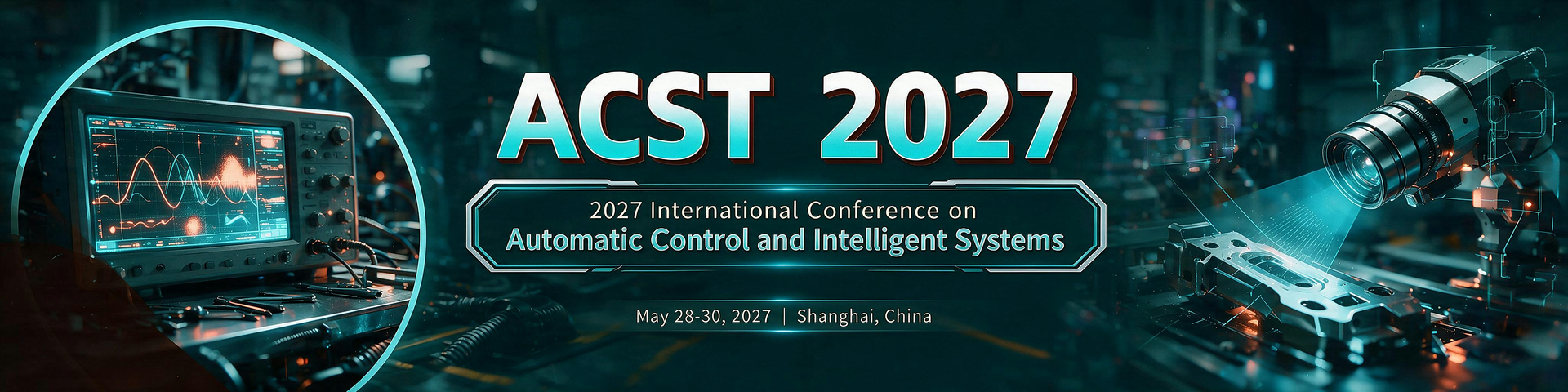
Welcome to ACST
2027 International Conference on Automatic Control and Intelligent Systems
Countdown to the Conference:
About ACST 2027
The 2027 International Conference on Automatic Control and Intelligent Systems (ACST 2027) will be held in Shanghai, China, from May 28 to 30, 2027. The conference aims to provide a global platform for researchers and engineering experts to exchange ideas and discuss recent advances in autonomous systems and intelligent control, industrial automation and process monitoring, robotics and intelligent equipment, cooperative control of unmanned systems, multi-sensor fusion and fault diagnosis, as well as interdisciplinary engineering applications of intelligent systems, with a focus on both fundamental theory and engineering innovation.
At present, automatic control and intelligent systems have become key enablers for industries such as intelligent manufacturing, smart cities, unmanned systems, and new energy. Emerging technologies including AI, big data, digital twins, and edge computing are profoundly reshaping the paradigm of control systems. New topics such as multi-platform coordination, swarm collaboration, and predictive maintenance are also expanding the frontiers of control science. ACST 2027 looks forward to bringing together innovative ideas and promoting interdisciplinary collaboration to jointly explore new opportunities for the coordinated development of intelligent control and autonomous systems.
Important Dates
Full Paper
Submission Date
March
14
2027
Notification of
Acceptance
April
28
2027
Registration
Deadline
May
07
2027
Conference
Dates
May
28-30
2027
Topics
The topics of interest for submission include, but are not limited to:
📚︎Autonomous Systems and Intelligent Control
· Control methods for autonomous systems; · Intelligent control technologies; · Autonomous decision-making and cooperative control; · Motion control in complex environments; · Intelligent agent control; · Unmanned system control;
📚︎Robotic Systems and Intelligent Equipment
· Industrial robots; · Mobile robots; · Service robots; · Special-purpose robots; · Intelligent equipment control; · Human-robot collaboration systems; · Robot perception and actuation;
📚︎Sensor Fusion, Fault Diagnosis, and Health Management
· Multi-sensor information fusion; · State estimation; · Fault detection and diagnosis; · Fault-tolerant control; · System health monitoring; · Predictive maintenance; · State assessment;
📚︎Industrial Automation and Process Control
· Industrial automation systems; · Process monitoring and control; · Production line automation; · Mechatronic system control; · Equipment operation optimization; · Industrial control system integration and applications;
📚︎Unmanned Systems and Cooperative Control
· Control, navigation, and mission planning of unmanned systems such as unmanned aerial vehicles, unmanned ground vehicles, and unmanned surface vehicles; · Multi-platform cooperative control; · Swarm collaboration; · System integration;
📚︎Intelligent Systems Applications and Cross-Disciplinary Engineering Practice
· Engineering applications of artificial intelligence in control systems; · Smart manufacturing; · Intelligent transportation; · Energy system control; · Automation technologies in medical and biological systems; · Edge intelligence; · Cloud-edge collaborative control;
Publication
All accepted full papers will be published in the conference proceedings and will be submitted to EI Compendex / Scopus for indexing.
Note: All submitted articles should report original research results, experimental or theoretical, not previously published or under consideration for publication elsewhere. Articles submitted to the conference should meet these criteria. We firmly believe that ethical conduct is the most essential virtue of academics. Hence, any act of plagiarism or other misconduct is totally unacceptable and cannot be tolerated.
Organizer
 |